RHC Causal Inference
AIPW ATE +0.059 · propensity AUC 0.786 · E-value 1.67
The clinical question
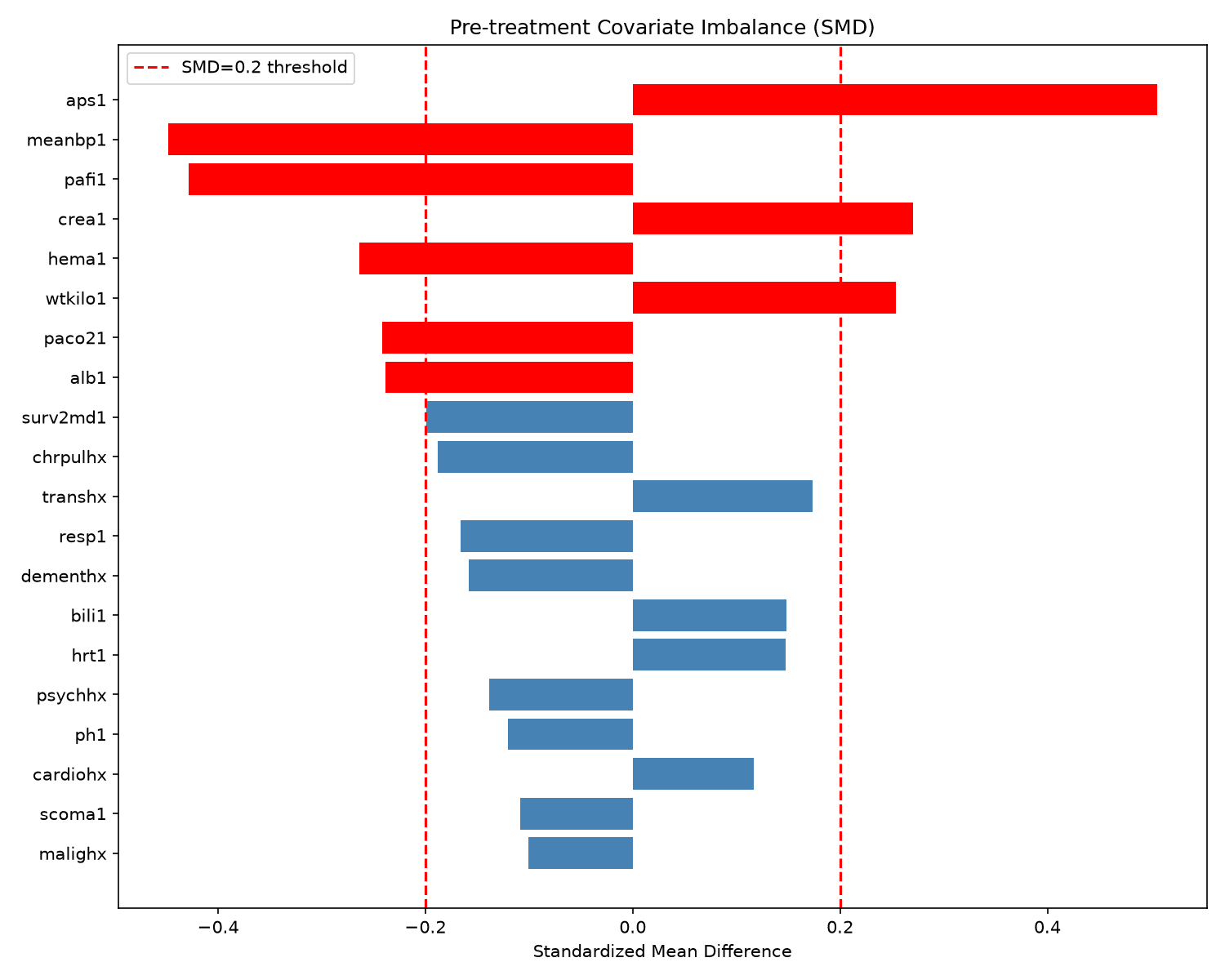
This project applies modern causal inference methods to the landmark Right Heart Catheterization dataset from the SUPPORT study (Connors et al. 1996, JAMA). The clinical question is whether RHC, an invasive diagnostic procedure, causally increases 30-day mortality in critically ill ICU patients, or whether the observed association is driven by confounding by indication (sicker patients are more likely to receive the procedure).
Method and estimates
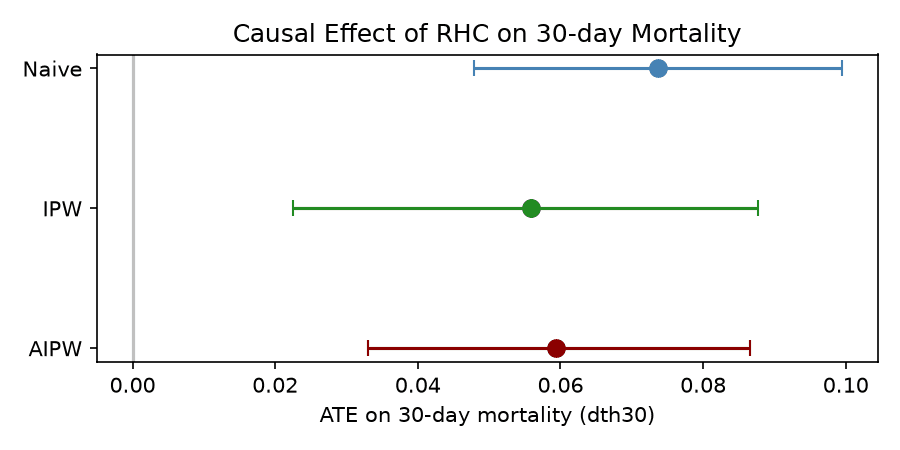
The analysis pipeline includes a logistic propensity score model on 65 pre-treatment confounders, three estimation strategies (naive comparison, stabilized inverse probability weighting, and augmented inverse probability weighting / doubly robust estimation), bootstrap confidence intervals, and E-value sensitivity analysis. The AIPW estimate of +0.059 on 30-day mortality (95% CI: +0.033 to +0.087) confirms that RHC is associated with increased mortality after adjustment, consistent with published benchmarks from Hirano and Imbens (2001) and Crump et al. (2009).
What the interactive demo shows
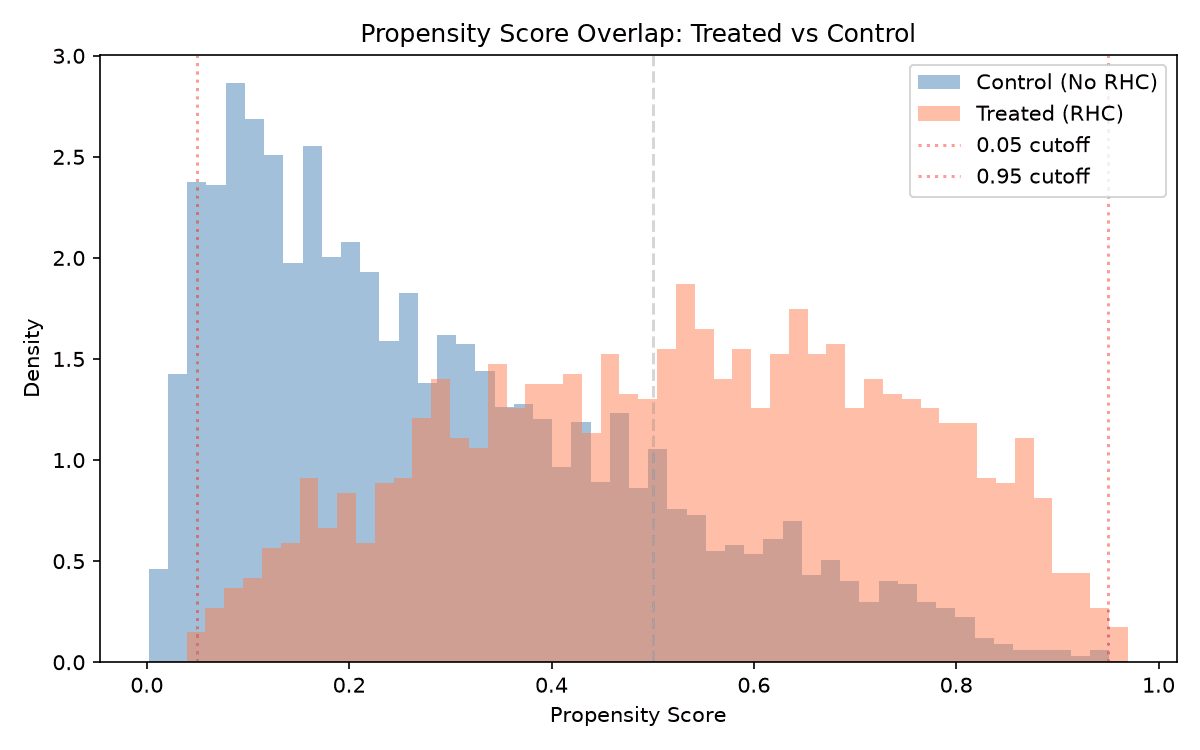
The interactive demo lets users define a hypothetical patient profile and see where their predicted propensity score falls on the actual overlap distribution, illustrating why common support matters for causal identification. Population-level treatment effect estimates are displayed as fixed results from the full analysis, not personalized predictions.
Why a 1996 dataset
Why use a 1996 dataset? The RHC dataset is the canonical benchmark in the causal inference literature. It has been re-analyzed by Hirano and Imbens (2001), Crump et al. (2009), Rosenbaum (2012), and dozens of subsequent methods papers through 2026. The known published estimates provide a hard validation gate: if your pipeline produces results outside the established range, you have a bug, not a discovery. No modern open-access clinical dataset offers this combination of rich confounders, a well-defined treatment decision, and independently verified ground truth. The dataset tests methodology, not recency.
Key results
- AIPW ATE: +0.059 (95% CI: +0.033 to +0.087)
- Propensity AUC: 0.786
- E-value: 1.67
Stack